
We recently devoted one of our We’re the Brits in America podcast episodes to the ongoing stock market turmoil, and how investors should react in this period of uncertainty.
At the time of writing, there is a blanket 10% tariff on all imports into the US, as well as tariffs on specific raw materials such as steel and aluminium.
While the original “bespoke” tariffs on most individual countries were suspended for 90 days by President Trump on 10 April, there is still the very real prospect of a trade war with China, that neither side seems prepared to withdraw from.
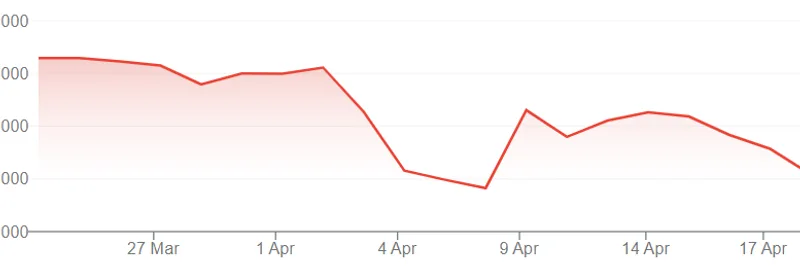
Markets don’t like uncertainty. Indeed, looking at some investment charts, such as the one below that shows the Dow Jones over one month to 22 April, you’d be forgiven for thinking you were on a theme park roller coaster.
Source: Google (22 April 2025)
All this volatility means it’s hard not to feel alarmed when you check the value of your 401(k), and other investments.
However, at a time like this, it’s important to keep a level head and a sense of perspective, and not to panic or behave irrationally.
Here are five suggestions of things you could do and, perhaps more importantly, don’t do, in the wake of all this bad financial news.
1. Stay invested and don’t be tempted to sell up
Your long-term investment plans will be based on detailed research and an analysis of your objectives.
However, a short-term emotional reaction to bad market news can quickly upset even the most robust plans.
History tells us that, over the long term, investing in stocks is the most effective way to grow your wealth. While reading the most recent JP Morgan Guide to Retirement, we found these remarkable statistics:
- The S&P 500 has produced an annualised return of 10.4% over the last 20 years. But if you had missed the 10 best trading days over that period, that figure reduces to 6.1%.
- 7 of those 10 best days occurred within a fortnight of one of the 10 worst days.
- 6 of those 7 were the day after one of the worst days.
The underlying takeaway from this information is that overreacting to bad news is likely to seriously damage your long-term wealth.
2. Tune out the noise
In a 24/7 media world with instant access to information and opinion, online comms can be a godsend. But, they can equally be a curse.
So, if you’re being bombarded by commentators reacting and then overreacting to every market event, it becomes natural to think that you should do the same.
The media love bad news. It sells papers and encourages clicks. Just search “billions wiped off the value of shares” and you’ll see the relish with which that information is imparted, notwithstanding the fact that such losses in value are only incurred if those shares are sold.
At times of uncertainty, it’s best to ignore the doom-mongers and do nothing. Note that this contains an active word, so you are making a conscious decision not to do anything.
It may sound trite to say it, but there’s a good reason why capitalism has been the dominant economic theory since Adam Smith wrote The Wealth of Nations. It has been able to adapt to every challenge thrown at it over 300 years, so that businesses and shareholders have continued to thrive.
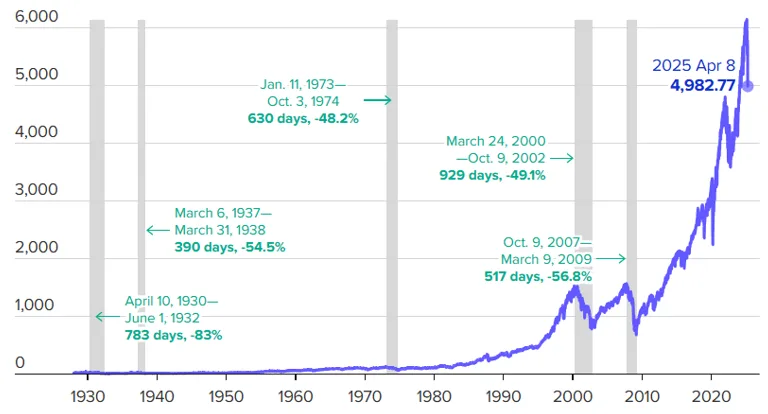
Furthermore, history tells us that markets recover after a bear market, as this chart of the biggest bear markets in S&P 500 history demonstrates.
Source: CNBC
Even if sweeping tariffs are eventually imposed, and the trade war with China continues, you can be confident that companies will develop new strategies to enable them to continue to invest and grow, and markets will recover.
3. Don’t try and time the market
It’s one of the oldest investment adages of all, but that doesn’t make it any less relevant at the current time. “It’s time in the market, not timing the market” is still just as apt today as it was when it was first uttered.
Trying to time the market is a fool’s errand, because unless you’re planning to stay in cash permanently, you need to get lucky twice. Firstly, to predict a downturn ahead of time, then to predict the floor and get back in at the bottom.
Sadly, there’s no Mark Haines around to tell us when we’re at the bottom, although no doubt any number of commentators, hoping to make a quick name for themselves, will try to predict it. Then you have the challenge of who to believe.
Instead, we would recommend you heed the advice of a real expert: Warren Buffett.
His famous comment that “the stock market is a device to transfer money from the impatient to the patient” is always worth bearing in mind at times like this.
4. Maintain a diversified portfolio
As well as staying invested, it’s also important not to overreact to market volatility in terms of where your money is invested.
It’s easy to see a big downturn in one particular sector or region as a prompt to move away from it.
Maintaining diversification in your portfolio can help to avoid any reliance on a single market sector and potentially mitigate some of the risk associated with the effects of a severe downturn.
5. Consider tax-loss harvesting
If you think you should be actively doing something, then you could consider tax-loss harvesting in your non-retirement accounts.
This is a tax strategy that involves selling non-profitable investments in taxable accounts at a loss to offset or reduce Capital Gains Tax (CGT) incurred from other investments you have sold for a profit in the same calendar year.
Additionally, if you then use the proceeds of the sale to replace the asset that was sold at a loss with a comparable asset in the same sector, you might not even upset the balance of your portfolio.
Tax-loss harvesting can be particularly advantageous if you are in a higher tax bracket, and tends to work best for individual stocks or actively managed accounts.
Get in touch
If you are a British expat living in the US and have concerns about your investment strategy, please get in touch to arrange an exploratory Zoom call to talk through your plans.
Please note
Plan First Wealth (PFW) is an SEC-registered investment adviser.
The information presented is for educational purposes only intended for a general audience. The information does not intend to make an offer or solicitation for the sale or purchase of any specific securities, investments, or investment strategies.
Investments involve risk and are not guaranteed.
PFW has reasonable belief that this marketing does not include any false or material misleading statements or omissions of facts regarding services, investment, or client experience.
PFW has reasonable belief that the content as a whole will not cause an untrue or misleading implication regarding the adviser’s services, investments, or client experiences.
PFW has presented information in a fair and balanced manner.
PFW is not giving tax, legal or accounting advice, consult a professional tax or legal representative if needed.



 Production