
As an expat in the US, you’ll be subject to different financial and taxation regulations to those that you were used to before you moved.
This can create challenges for your financial planning that can be both time-consuming and complicated, with the associated hazard that any mistakes you make might be irreversible and leave you facing an unwelcome tax demand from the IRS.
At the same time, you will also be looking to grow your wealth in a financial regime that you may not be familiar with, as well as ensuring you have effective estate planning measures in place to manage your legacy.
These factors, and the potential negative impact of making incorrect decisions, highlight the importance of getting expert cross-border advice.
Here are five specific ways that working with an experienced financial planner can help reduce the stress involved with the challenges you face as an expat in the US.
1. Tax planning across different jurisdictions
In these articles we often refer to the importance of avoiding “landmines” that can have a detrimental effect on your finances. The US tax system, and how it interacts with overseas income and assets, is responsible for some of the most common landmines that we come across.
We highlighted one of these recently in a blog post about passive foreign investment companies.
Effective cross-border financial planning can help you understand the effect of double-taxation agreements between different countries, and how you can mitigate the effect of tax on your income and assets. You may also be able to take advantage of tax treaties between nations to help reduce your tax bill.
As an expat in the US, we can help you establish a clear idea as to how different types of income are taxed and how the US tax regime can affect your long-term financial plan.
2. Investing your money to grow your wealth
As well as establishing and maintaining tax compliance, expert advice can be essential for maximising your wealth through your investment portfolio.
Adopting a DIY approach can be time-consuming and stressful, particularly in the wake of market upheaval like the kind we experienced in April 2025.
Effective cross-border investment planning will ensure that your plans address key issues such as asset allocation, your attitude to risk, and the length of time your money is invested. What’s more, you may be able to make the most of tax mitigation opportunities such as tax-loss harvesting.
3. Planning for your retirement
Alongside growing your wealth, ensuring you can enjoy the retirement you have worked hard for will be one of your top priorities.
Even if you don’t intend to stop working just yet, there are still important cross-border related decisions you will need to make where expert advice can be crucial.
These decisions include:
- Managing retained pension benefits when you leave one country to live and work in another
- Figuring out where you intend to retire
- Determining the effect of exit taxes if you leave the US.
No two sets of personal circumstances are the same, and we will provide you with bespoke advice tailored to your own objectives and future plans.
4. Maximising the wealth you pass to your beneficiaries
Being an expat in the US, with substantial assets in other countries, makes it imperative for you to review your legacy arrangements.
Estate planning tools such as wills and trusts can vary between different jurisdictions, and there may be issues around how these documents are interpreted and applied in a different country to where they were drawn up.
New legislation can also affect your legacy planning, such as the changes to UK Inheritance Tax announced in the October 2024 Budget, which are set to come into force in April 2027.
We work closely with a US-based estate planning provider to ensure that your plans are robust and that you are completing the correct documentation – including wills and trusts – to align with your legacy plans.
In this way, we can help you ensure that your US and offshore assets pass to your beneficiaries as smoothly and tax-efficiently as possible.
Find out more: Estate planning for British expats in America
5. Securing competitive returns on your currency exchange transactions
As you will no doubt appreciate, currency exchange rates can significantly impact your cross-border financial transactions.
That can particularly be the case if you have regular earnings from a non-US source, such as a property portfolio or your UK state pension, that you are transferring to the US. Likewise, if you receive a substantial inheritance.
For example, the sterling to US dollar exchange rate is constantly fluctuating, and over the last five years has ranged between $1.08 and $1.41 to the pound.
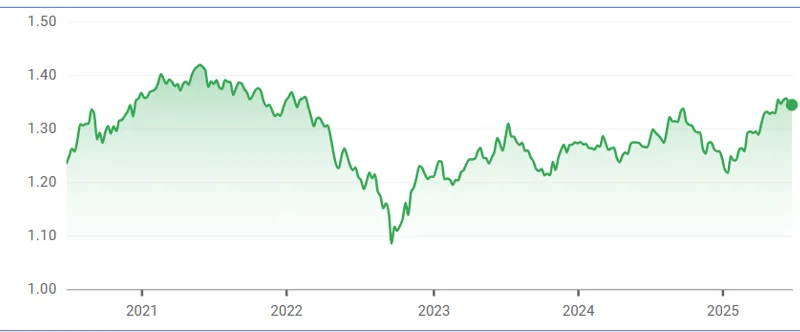
Source: Google
If you are transferring regular amounts or a large lump sum, it makes sound financial sense to get the best rate possible. Even a few extra dollars can make a big difference.
We work with currency specialists who can help you benefit from real-time exchange rates as well as providing access to forward contracts, allowing you to lock in exchange rates and reduce the risk inherent in these type of transactions.
Get in touch
If you are a British expat living in the US and would like to talk about your own plans, please get in touch to arrange an exploratory Zoom call to talk through your options.
Please note
Plan First Wealth (PFW) is an SEC-registered investment adviser.
The information presented is for educational purposes only intended for a general audience. The information does not intend to make an offer or solicitation for the sale or purchase of any specific securities, investments, or investment strategies.
Investments involve risk and are not guaranteed.
The content of this email should not be construed as or relied upon as legal or tax advice in any particular circumstance or fact situation. PFW disclaims any liability arising out of your use of, or any tax position taken in reliance on, such information. Always consult an attorney or tax professional regarding your specific legal or tax situation.
PFW has reasonable belief that this marketing does not include any false or material misleading statements or omissions of facts regarding services, investment, or client experience.
PFW has reasonable belief that the content as a whole will not cause an untrue or misleading implication regarding the adviser’s services, investments, or client experiences.
PFW has presented information in a fair and balanced manner.



 Production